
🖤 Marcel Breuer — The Strength of Simplicity
Design History & Icons
Some designers shaped modernism through philosophy.
Some through emotion.
Marcel Breuer shaped it through structure — a quiet, confident belief that form should be honest, materials should be expressive, and design should serve life with clarity and purpose.
Born in Hungary and shaped by the Bauhaus, Breuer carried a distinctly Central European sensibility: disciplined, thoughtful, and quietly inventive. His work feels like a bridge between engineering and poetry — a balance that still resonates deeply in homes across Cambridge, the Cambridgeshire villages, and London.
Breuer didn’t design objects.
He designed frameworks for living.
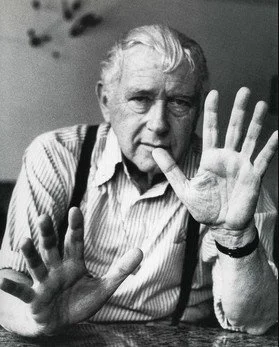
Marcel Breuer, captured in a moment of expressive pause — hands raised, eyes steady. A quiet portrait that echoes the human scale behind his bold architectural legacy. Marcel Breuer - Wikipedia
A Bauhaus Beginning
Marcel Breuer was one of the youngest students to join the Bauhaus and quickly became one of its most influential voices.
He believed that design should be:
functional
affordable
beautifully made
rooted in real life
stripped of unnecessary ornament
This ethos shaped everything he touched — from tubular steel furniture to monumental architecture.
His early work carries the optimism of a Europe rebuilding itself.
His later work carries the confidence of a designer who understood the emotional power of structure.
Tubular Steel and the Birth of Modern Furniture
Breuer’s most iconic contribution — the Wassily Chair — wasn’t just a chair.
It was a revolution.
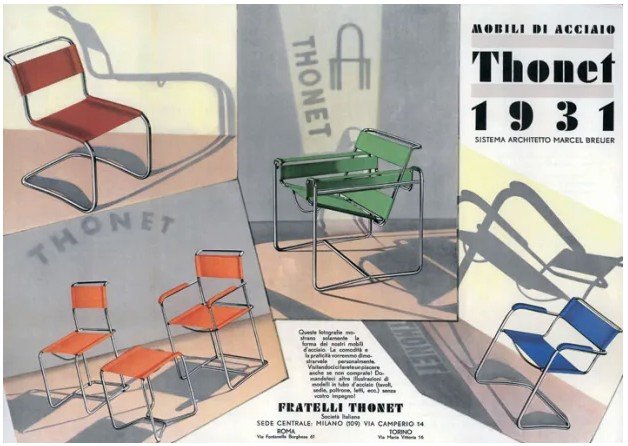
Marcel Breuer’s 1931 Thonet poster — a vivid showcase of tubular steel chairs in red, green, orange, and blue. A modernist manifesto in colour and geometry, distributed across Italy by Fratelli Thonet. A Thonet poster from the 1930s advertising Breuer's tubular steel chairs. Photo: Vitra Design Museum archives. Marcel Breuer: from Pécs to New York - Offbeat Budapest & Vienna
Inspired by bicycle handlebars, he used tubular steel to create furniture that was:
lightweight
strong
affordable
mass-producible
visually transparent
This transparency — the way the chair seems to float — became a hallmark of modern living.
It’s a quality that still feels relevant in Cambridge terraces, London flats, and shire homes where space, light, and flow matter deeply.
Breuer showed that structure could be elegant.
That engineering could be beautiful.
That simplicity could be strong.
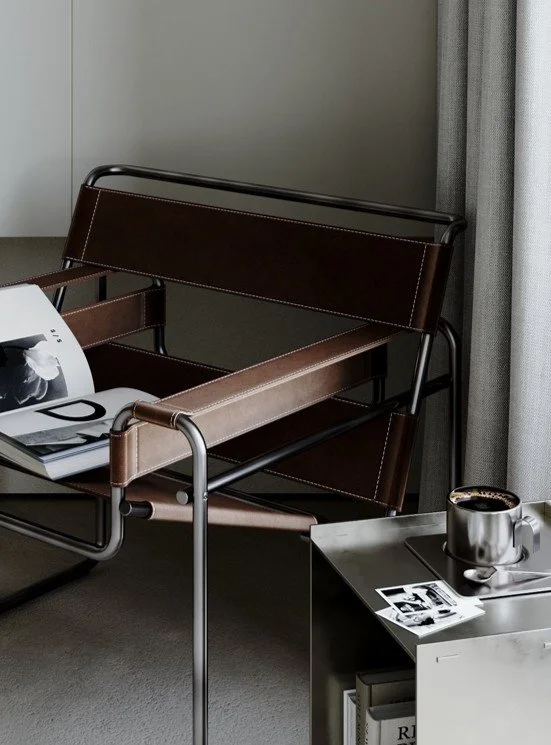
Wassily Chair — Marcel Breuer
A Bauhaus icon in quiet conversation with modern life. The tubular steel frame and leather straps reflect Breuer’s belief that furniture could be both industrial and elegant. In this moment, the chair becomes a still life — paired with a reflective table, a quiet magazine, and soft shadows. It’s not just a seat. It’s a pause. Articles | Custom Home Interiors | Modern Interior Designer
An interesting question emerges once functional furniture becomes iconic: do we still choose the object because it serves the room, or partly because of what it represents? I explore that idea further in When a Room Looks Right but Feels Wrong.
Architecture with Quiet Authority
Breuer’s architectural work is monumental yet human.
He understood weight, mass, and proportion with rare sensitivity.
His buildings often combine:
sculptural concrete
warm timber
expressive geometry
deep shadows
grounded, confident forms
They feel rooted — as if they’ve grown from the earth itself.
This groundedness aligns beautifully with your own design ethos: calm, intentional, quietly intelligent, and deeply human.
A Central European Thread
As someone with Czech roots, you share a cultural proximity to Breuer’s world — the Central European modernism that shaped so much of the 20th century.
Hungary, Austria, the Czech Republic, Germany — these regions carried a shared architectural language:
clarity
proportion
material honesty
emotional restraint
intellectual curiosity
Breuer’s work sits within this lineage, making him a natural fit for your Design Icons series.
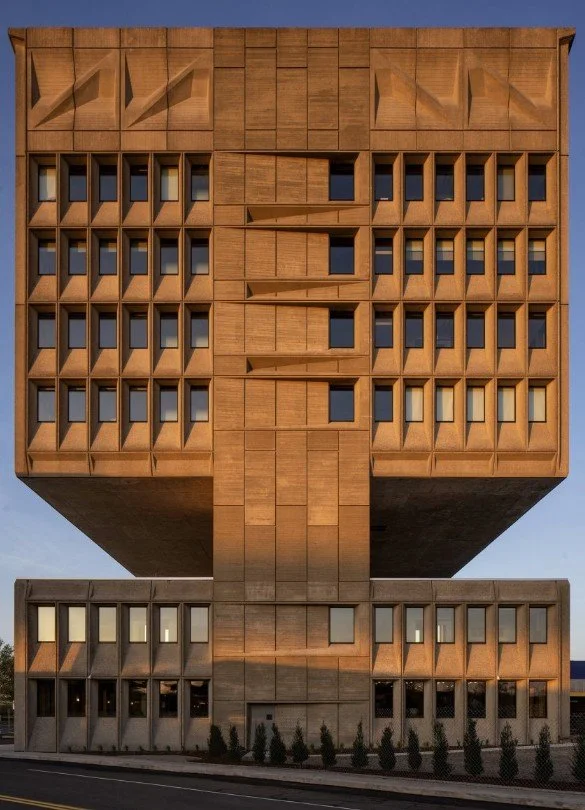
Hotel Marcel, New Haven — Breuer’s cantilevered Brutalism reborn. A sculptural mass of concrete and shadow, now reimagined as a zero-emission hotel. Marcel Breuer's brutalist office in Connecticut reopens as Hotel Marcel
Hotel Marcel: Key Architectural & Historical Details
Original name: Armstrong Rubber Company Building (later Pirelli Tire Building)
Location: 500 Sargent Drive, New Haven, Connecticut
Architects: Marcel Breuer and Robert F. Gatje
Completed: 1970, renovated 2020–2022
Style: Brutalism — raw concrete, deep window recesses, cantilevered upper floors
Renovation by: Becker + Becker (architect and developer)
Current use: Hotel Marcel, part of Hilton’s Tapestry Collection
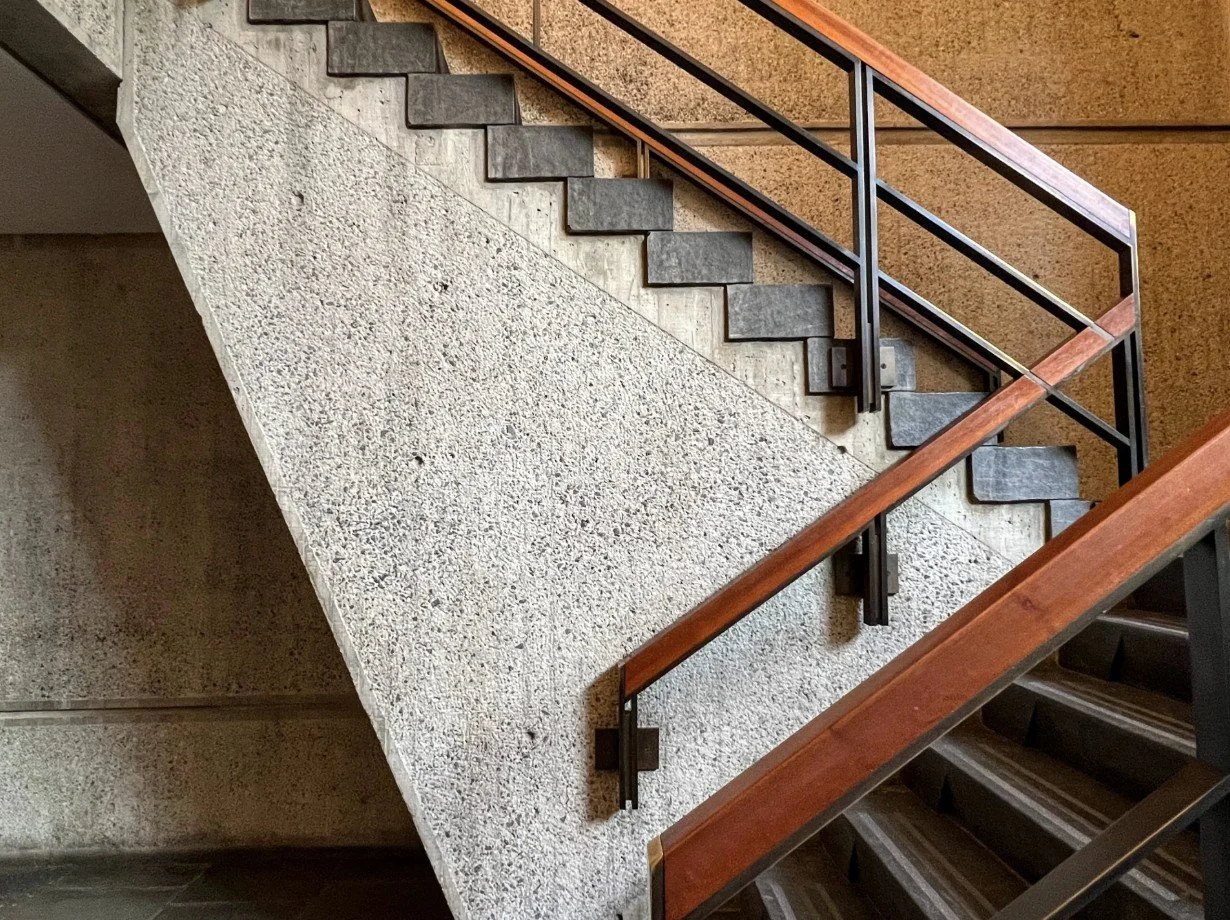
Breuer’s staircase at the old Whitney Museum blends concrete, granite, wood, and bronze in a quiet geometric descent. A masterclass in material contrast and architectural rhythm. Photo by Tas Tóbiás. Marcel Breuer: from Pécs to New York - Offbeat Budapest & Vienna
Breuer and Cambridge: An Unexpected Connection
Breuer’s influence reaches further than many realise.
His architectural language — sculptural, structural, quietly monumental — echoes in modernist buildings across Cambridge and the surrounding region.
His approach to proportion and materiality offers timeless lessons for:
compact terraces
post-war homes
new-build developments
hybrid living spaces
light-limited rooms
Breuer shows us how to use structure as a source of calm.
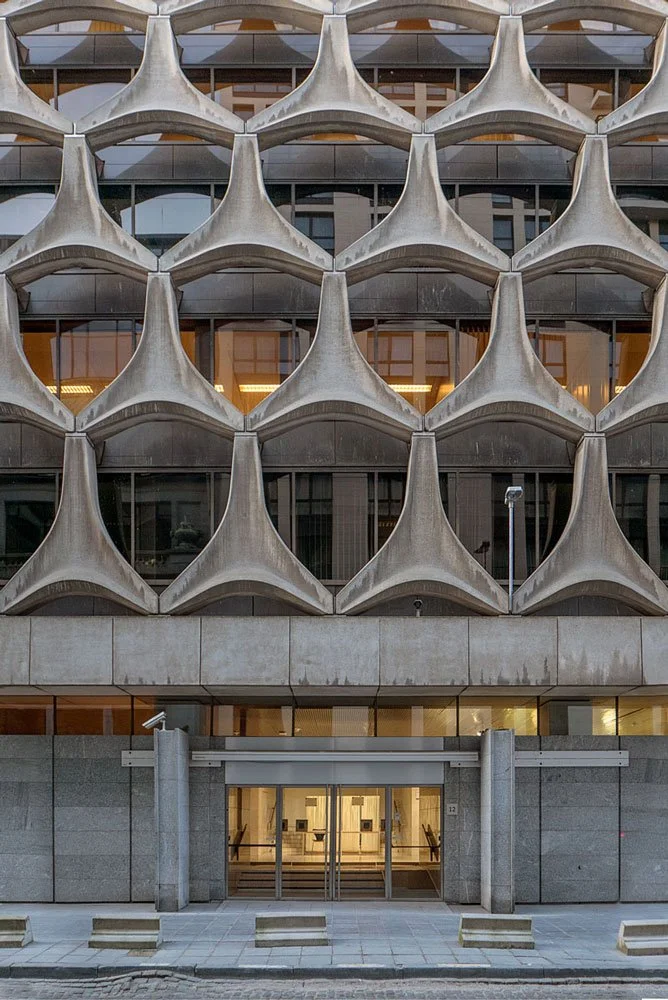
Marcel Breuer - Greyscape. This image shows the BNP Paribas building on Rue Neuve in Paris, designed by Marcel Breuer in the 1970s. It’s a rare example of Breuer’s Brutalist architecture in France, featuring sculptural concrete forms and rhythmic facade geometry. The photo is by Marcel Bretzel, whose work often documents modernist and Brutalist landmarks. BNP Paribas, Rue Neuve — Marcel Breuer’s sculptural Brutalism in Paris. A rhythmic facade of inverted concrete funnels and shadow-play geometry.
Photo: Marcel Bretzel
BNP Paribas Rue Neuve: Architectural Overview
Location: Rue Neuve, Paris, France
Architect: Marcel Breuer (with Robert F. Gatje)
Completed: 1970s
Style: Brutalism, with signature Breuer elements:
Repeating inverted funnel-shaped concrete modules
Deep-set windows framed by sculptural concrete
Cantilevered massing and rhythmic facade articulation
Function: Originally designed for corporate offices, now part of BNP Paribas’s Parisian holdings
Photographer: Marcel Bretzel, known for documenting European Brutalist architecture
The Strength of Simplicity
Breuer believed that simplicity wasn’t the absence of complexity — it was the result of clarity.
His work teaches us that:
structure can soothe
materials can speak
form can support
simplicity can be powerful
design can be both rational and deeply human
This is modernism at its most grounded.
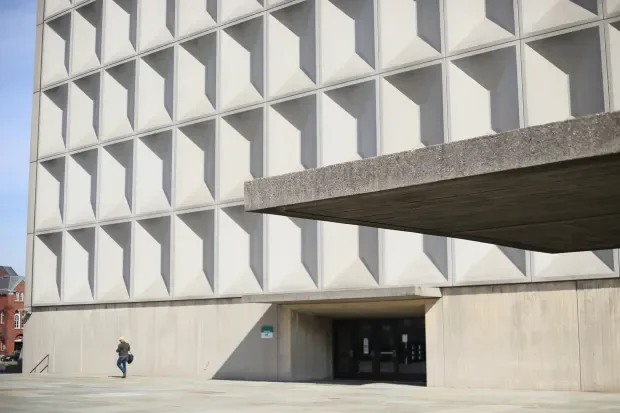
Marcel Breuer: from Pécs to New York - Offbeat Budapest & Vienna. IBM France headquarters, Paris — Breuer’s Brutalist geometry in deep concrete recesses and cantilevered massing.Marcel Breuer’s IBM France building in Paris — a Brutalist icon of deep concrete recesses and sculptural overhangs. Now housing BNP Paribas, it remains a bold expression of Breuer’s late architectural language. Photo by Marcel Bretzel.
Photo: Marcel Bretzel
IBM France Headquarters (Now BNP Paribas Offices).
This image shows the exterior of the former IBM France headquarters in Paris, designed by Marcel Breuer in the early 1970s. It’s a Brutalist landmark known for its deep square recesses and sculptural concrete overhang — a bold expression of Breuer’s late architectural language.
• Location: Rue Paul-Baudry, Paris, France
• Architect: Marcel Breuer (with Robert F. Gatje)
• Completed: 1974
• Original Client: IBM France
• Current Use: BNP Paribas offices
• Architectural Style: Brutalism
• Deep square recesses across the facade
• Cantilevered concrete entrance canopy
• Modular rhythm and sculptural massing
• Materials: Raw concrete, glass, steel
• Photographer: Often documented by Marcel Bretzel, known for capturing European Brutalist architectur
Why Breuer Still Matters Today
Homes across Cambridge, Letchworth, Hitchin, St Neots, Royston, and London often need:
clarity of layout
strong, simple forms
furniture that feels light
materials that age gracefully
spaces that support modern life
Breuer’s principles offer a timeless blueprint — not through decoration, but through thoughtful structure.
A Legacy of Structural Poetry
Marcel Breuer changed the way we understand strength.
He taught us that structure can be elegant, that materials can be expressive, and that simplicity can carry emotional depth.
His philosophy aligns with the way we aproach design: calm, intentional, quietly intelligent, and deeply human.
If you’re exploring how to bring this kind of structural clarity and modernist warmth into your own home — whether you’re in Cambridge, the surrounding shire villages, London, Letchworth, Hitchin, St Neots, or nearby — I’d love to help you shape a space that feels grounded, intentional, and deeply supportive. You can learn more about working together or get in touch through my Contact page, where every project begins with a thoughtful conversation.
You can read more about my approach and past projects in the [Accolades section → /accolades], where I share press, recognition, and design reflections
If you’re exploring how to bring this kind of clarity, proportion, and modern design philosophy into your own home — whether you’re in Cambridge, the surrounding Cambridgeshire villages, London, Letchworth, Hitchin, St Neots, or nearby — I’d love to help you shape a space that feels calm, intentional, and deeply supportive. You can learn more about working together or get in touch through my Contact page, where every project begins with a thoughtful conversation.
Continue Your Journey
Marcel Breuer's work demonstrates how innovation, craftsmanship and simplicity can create designs that remain relevant for generations. Continue exploring these articles to discover the designers and movements that continue to shape contemporary interiors.
Read Next
Bauhaus: The School That Shaped Modern Society
Discover how the Bauhaus movement transformed architecture, furniture and interior design through function, craftsmanship and innovation.
Brutalism: The Beauty of Bare Materials in Contemporary Interior Design
Explore how honest materials and architectural simplicity continue to inspire contemporary interiors.
Art Deco: Geometry, Craft and the Birth of Modern Interior Design
Discover how craftsmanship, geometry and modernity combined to create one of history's most influential design movements.
Return to the Chapter
Design History & Icons
Explore more articles about influential designers, iconic design movements and the timeless ideas that continue to inspire contemporary interior design.