
🖤 Alvar Aalto — The Warmth of Modernism
Design History & Icons
Some designers shaped modernism through clarity and structure.
Alvar Aalto shaped it through warmth — a quiet, human-centred modernism rooted in nature, emotion, and the belief that design should feel like a gentle companion to everyday life.
Where others pursued precision, Aalto pursued comfort.
Where others celebrated steel and glass, he celebrated timber, curves, and light.
His work feels like a conversation between architecture and landscape — a dialogue that still resonates deeply in homes across Cambridge, the shire villages, and London, where people long for spaces that feel grounded, calm, and quietly alive.
Aalto didn’t design objects.
He designed experiences.
If you’re curious how other design icons shaped modernism, you can explore my [Design History & Icons collection → /design-history-icons].
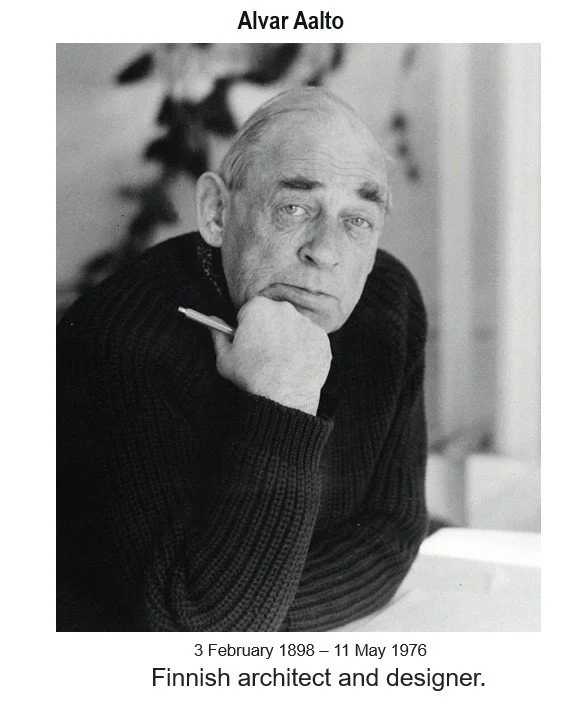
Alvar Aalto (Finland, 1898–1976)
A quiet moment with the architect who shaped modernism through warmth. Seated with pencil in hand, Aalto’s gaze reflects the empathy and emotional intelligence that defined his work. His designs weren’t just structures — they were companions to daily life, shaped by nature, light, and human rhythm.
A Human-Centred Modernism
Aalto believed that modernism should never feel cold.
He saw design as a way to support the rhythms of daily life — the way people sit, move, gather, rest, and breathe.
His approach was rooted in:
natural materials
soft, organic forms
warm light
human scale
emotional comfort
If you’re curious how I bring this kind of emotional clarity into real homes, you can explore my [Interior Design Services → /services].
This is why his work feels timeless.
It doesn’t demand attention.
It simply supports you.
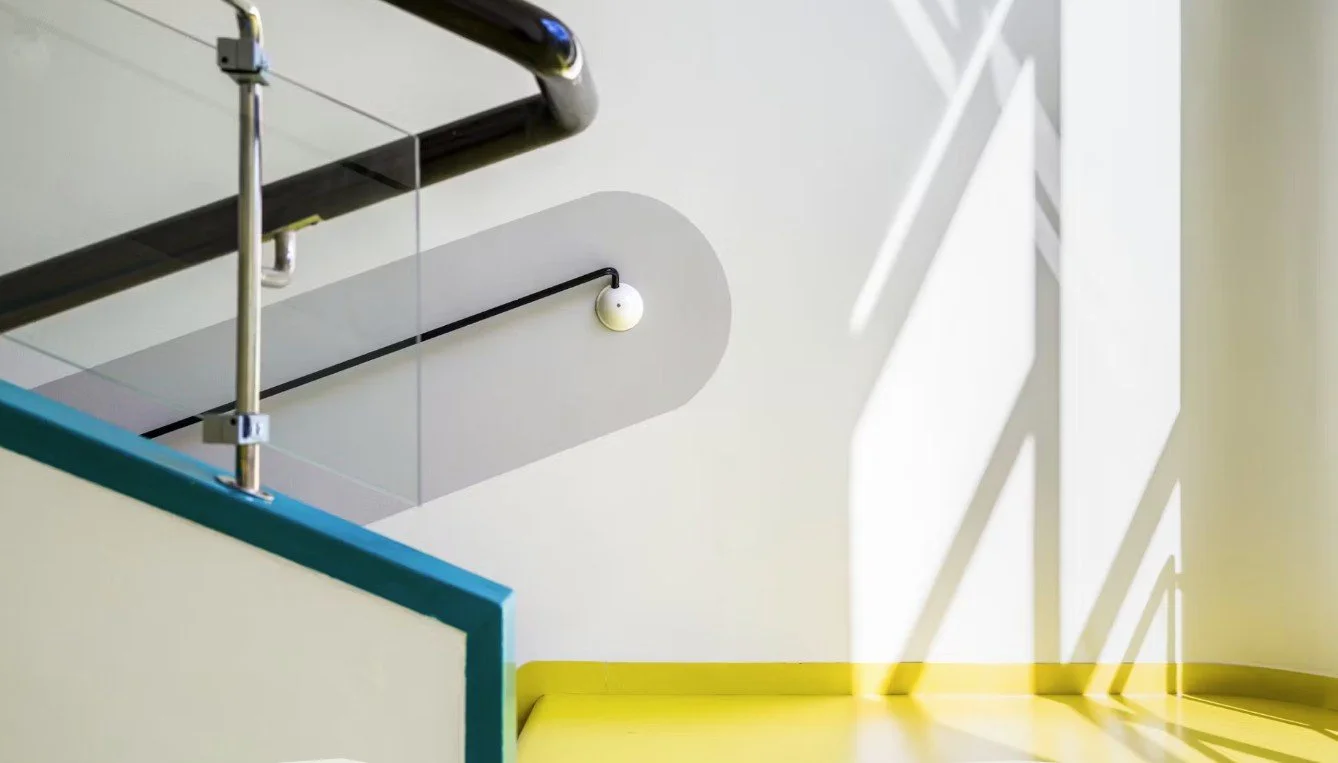
Paimio Sanatorium — Stairwell Detail
Aalto’s architecture as movement. This stairwell captures his belief that healing spaces should feel rhythmic, light-filled, and emotionally clear. The yellow floor, sculptural shadows, and minimalist lighting create a quiet choreography of care — a space where geometry meets empathy. Exploring Alvar Aalto’s Paimio Sanatorium | Wellcome Collection
In many ways, Aalto anticipated the needs of modern living in Cambridge and the shire — homes that must balance work, family, and rest while still feeling gentle and grounded.
Nature as Architecture
Where Le Corbusier sought order, Aalto sought harmony.
He believed that architecture should grow from the landscape, not sit on top of it.
His buildings curve, soften, and open themselves to light in ways that feel almost musical.
He used:
timber for warmth
brick for grounding
glass for softness
curves for movement
light for emotional clarity
This connection to nature aligns beautifully with your own design ethos — calm, intentional, and deeply human.
If you’re curious about the ethos behind my own work, you can explore my [About page → /about].
The Poetry of Curves
Aalto’s curves weren’t decorative.
They were functional empathy.
He believed that straight lines belonged to machines, and curves belonged to people.
His furniture — especially the iconic Paimio Chair and Stool 60 — feels like an embrace, shaped to support the body with quiet intelligence.
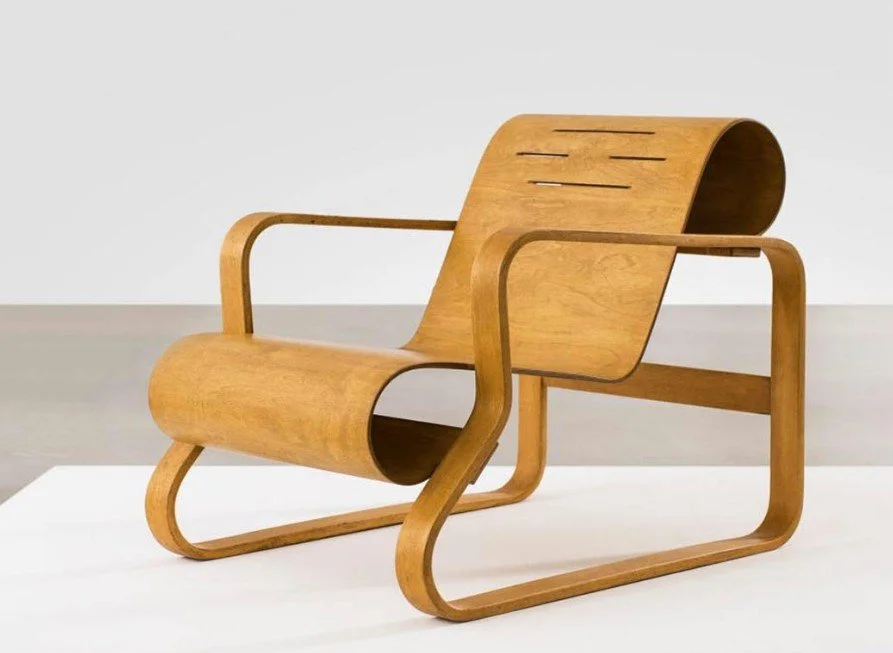
Paimio Chair — Alvar Aalto
A chair shaped like empathy. Crafted from bent plywood, its curves support the body with quiet intelligence. This is not decoration — it’s functional care. Aalto believed that straight lines belonged to machines, and curves belonged to people. The Paimio Chair remains a lesson in how form can express comfort, rhythm, and emotional warmth. Alvar Aalto: Effortlessly Modern Design - Invaluable
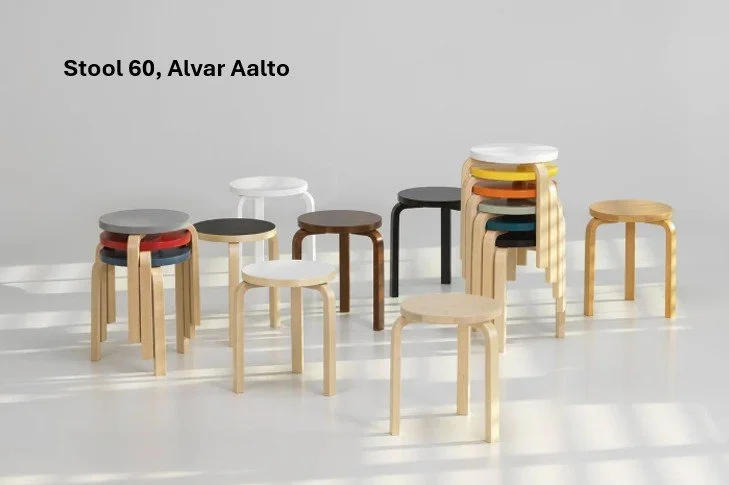
Stool 60 — Alvar Aalto
A quiet circle of empathy. Designed in 1933, Stool 60 reflects Aalto’s belief that furniture should support the rhythms of daily life. Its bentwood legs curve with functional grace, and its stackable form speaks to both simplicity and generosity. These stools are not just objects — they are companions to modern living, shaped by care, clarity, and emotional warmth. Artek Aalto Stool 60 | twentytwentyone
These pieces are not just design icons.
They are lessons in how form can express care.
If you’re curious how furniture can shape emotion, you can explore my [Design History & Icons article on Eileen Gray → /design-history-icons/eileen-gray].
Light as a Healing Force
Aalto understood light with rare sensitivity.
In Finland, where winter light is scarce, he learned to treat it as a precious material — something to be shaped, softened, and guided.
His interiors glow rather than shine. Light is diffused, reflected, and layered to create emotional warmth.
This approach translates beautifully to Cambridge terraces, London flats, and shire homes, where natural light can be limited.
Aalto shows us how to make light feel generous, even when it is scarce.
If you’re curious how I work with light in real homes, you can explore my [Showcase of completed projects → /showcase].
Architecture for Wellbeing
Aalto’s work in hospitals, libraries, and civic buildings reveals his belief that design can support healing, learning, and community.
The Paimio Sanatorium is the clearest example.
Every detail — from the angle of the chairs to the colour of the ceilings — was designed to support recovery.
This is modernism at its most compassionate.
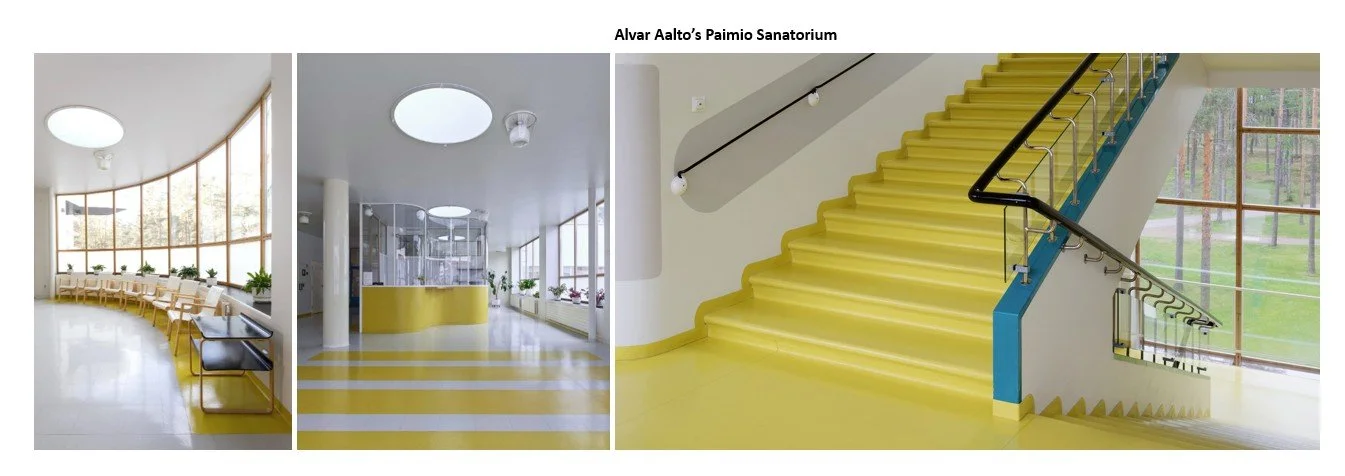
Paimio Sanatorium — Alvar Aalto
Aalto’s architecture as empathy. These interiors reveal his belief that design can support wellbeing — through light, colour, movement, and human rhythm. From the curved waiting room to the yellow staircase, every detail was shaped to ease the body and lift the spirit. This is modernism at its most compassionate: not cold, not mechanical, but quietly alive. Teachings from Paimio, a contemporary monument to care | January Architecture | Hospital architecture.
Not cold.
Not mechanical.
But deeply human.
If you’re curious how design can support wellbeing, you can explore my [Interior Design Services → /services].
Why Aalto Still Matters Today
Homes across Cambridge, Letchworth, Hitchin, St Neots, Royston, and London often face similar challenges:
limited natural light
the need for multifunctional spaces
a desire for warmth and emotional grounding
the balance between modernity and comfort
Aalto’s principles offer timeless guidance.
He shows us that modernism can be soft, warm, and deeply supportive — a way of living that feels both contemporary and comforting.
If you’re curious how I help clients resolve these exact challenges, you can start a conversation through my [Contact page → /contact].
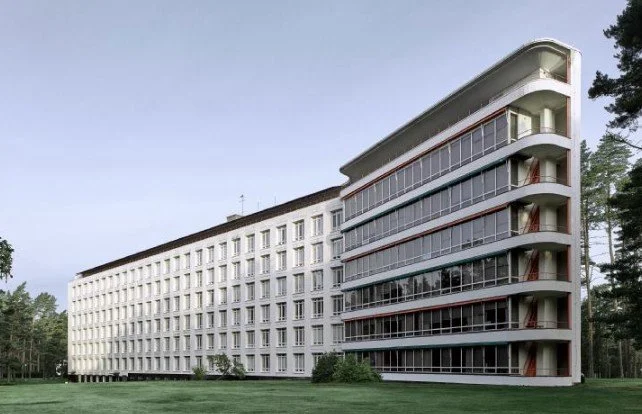
Paimio Sanatorium — Exterior View
A building shaped by care. Aalto’s design curves gently into the forest, with rhythmic balconies and soft colour accents that echo the landscape. This wasn’t just architecture — it was a philosophy of healing. The Sanatorium’s form, light, and setting were all shaped to support recovery, rest, and emotional clarity. Alvar Aalto, Fabrice Fouillet · Paimio Sanatorium · Divisare
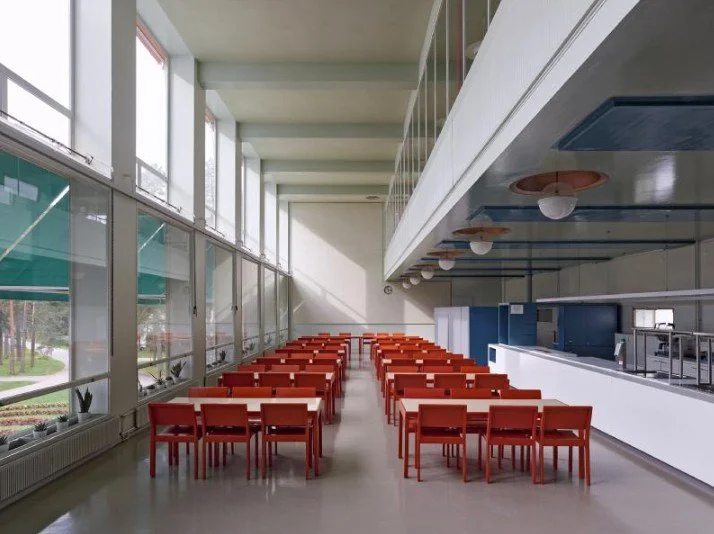
Paimio Sanatorium — Dining Hall
Aalto’s architecture of wellbeing. This dining hall reflects his belief that even institutional spaces should feel generous and emotionally supportive. Natural light, rhythmic colour, and quiet symmetry create a space shaped for recovery, community, and calm. Every detail — from the red chairs to the green awnings — feels intentional, human, and quietly alive. Alvar Aalto, Fabrice Fouillet · Paimio Sanatorium · Divisare
A Quiet Thread to Your Own Practice
Your design ethos — calm, intentional, emotionally intelligent — aligns beautifully with Aalto’s belief that homes should feel like places of rest and renewal.
His work reminds us that modernism doesn’t have to be sharp.
It can be gentle.
It can be human.
It can be alive.
A Legacy of Warm Modernism
Alvar Aalto changed the way we understand comfort.
He taught us that modern design can be warm, natural, and emotionally resonant.
His philosophy aligns with the way I design:
calm, intentional, quietly intelligent, and deeply human.
If you’re exploring how to bring this kind of warm, human-centred modernism into your own home — whether you’re in Cambridge, the surrounding Cambridgeshire villages, London, Letchworth, Hitchin, St Neots, or nearby — I’d love to help you shape a space that feels grounded, intentional, and deeply supportive. You can learn more about working together or get in touch through my Contact page, where every project begins with a thoughtful conversation.
If you’re curious about the process of working together, you can explore my [Interior Design Services → /services].
Continue Your Journey
Alvar Aalto believed that great design should improve everyday life through simplicity, craftsmanship and a deep understanding of people. Continue exploring these articles to discover the designers and movements that continue to shape contemporary interiors.
Read Next
Marcel Breuer — The Strength of Simplicity
Discover how Marcel Breuer's innovative approach to structure and materials helped redefine modern furniture and interior design.
Bauhaus: The School That Shaped Modern Society
Explore how the Bauhaus movement transformed architecture and design through simplicity, craftsmanship and function.
Scandinavian and Nordic Interior Design Ideas for Cambridge Homes
Discover how Scandinavian design continues the tradition of creating calm, functional and beautifully human-centred homes.
Return to the Chapter
Design History & Icons
Explore more articles about influential designers, iconic design movements and the timeless ideas that continue to inspire contemporary interior design.