
Disruption Within Control: Why the Most Memorable Interiors Break One Rule
Some interiors are beautiful, balanced and impeccably finished — and yet, somehow, we forget them.
Others stay with us.
Perhaps it is an unexpected colour overhead. A highly polished surface within an otherwise quiet material palette. A contemporary object sitting confidently against historic architecture. A curve interrupting a rigid geometry. Something that seems, at first, not quite to belong.
And yet it does.
The difference is rarely randomness.
The most memorable interiors often establish a clear sense of order first — proportion, rhythm, repetition, material language, alignment, visual calm — and then introduce one carefully judged interruption.
Before something can break the rhythm, there has to be a rhythm.
Before contrast can have impact, there has to be something to contrast against.
And before we break a rule, perhaps we first need to understand why the rule exists.
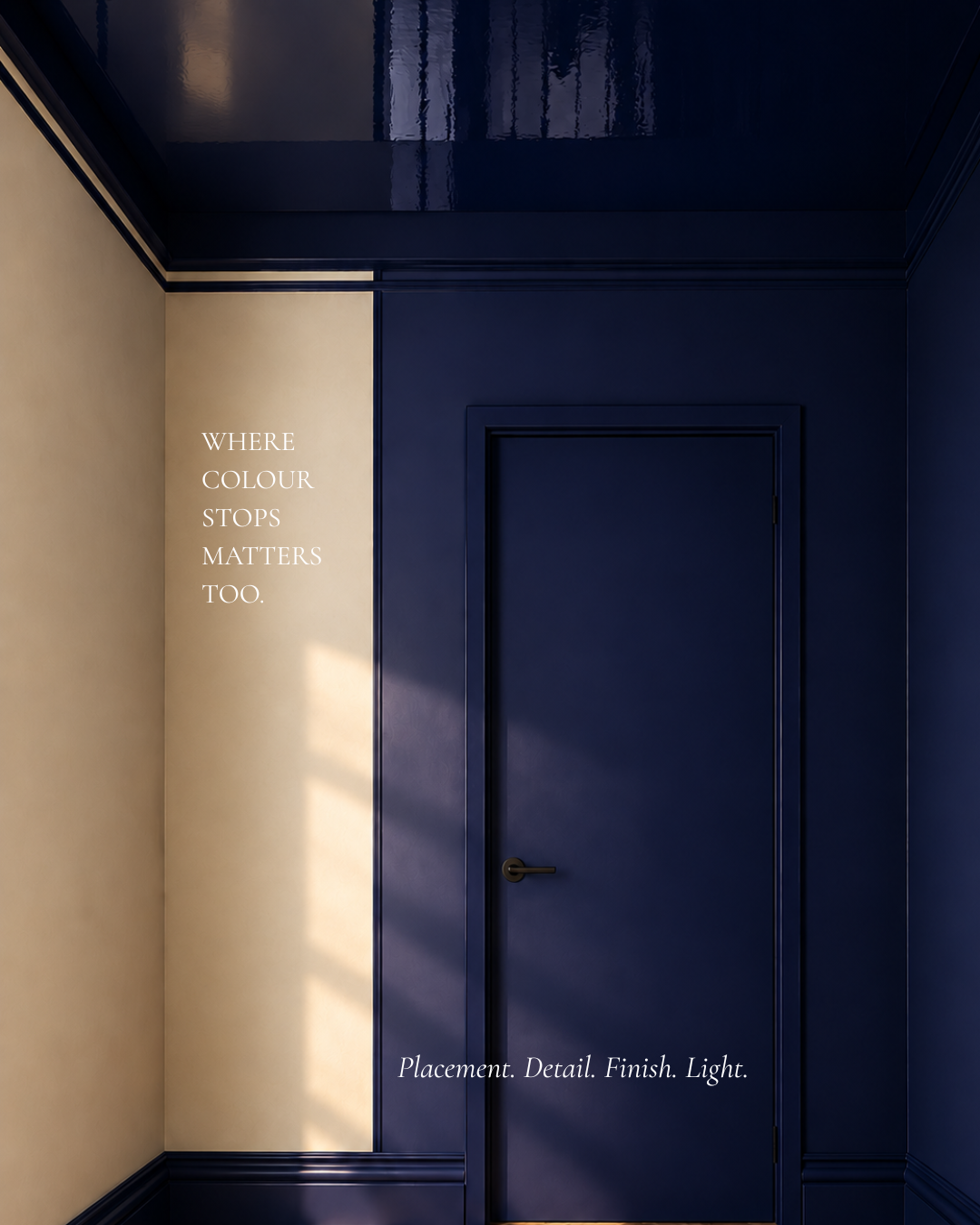
Colour becomes architectural when placement, finish and light are considered as part of the composition, rather than applied as decoration.
The Discipline Behind the Surprise
Good interiors depend on relationships.
The relationship between furniture and architecture. Between mass and empty space. Between light and shadow. Between materials, scale, colour and movement through a room.
This is why proportion and balance matter long before we begin thinking about individual pieces.
When those relationships are resolved, a room develops an internal logic. The eye may not consciously analyse it, but we feel it.
There is somewhere to rest.
There is hierarchy.
Not everything is trying to be important at the same time.
This is where disruption becomes interesting.
A surprising decision within a chaotic room simply adds another layer of noise. The same decision within a controlled composition can become the element that gives the room its identity.
Successful disruption is therefore not the opposite of restraint.
It depends on it.
Modernism Was Never Just About Modern Furniture
Modernism is often reduced to a recognisable visual vocabulary.
Tubular steel. Geometric furniture. Glass. Chrome. Flat planes. Minimal decoration.
Those things are part of its history, but they are not what interests me most about Modernism.
What interests me is the thinking.
Modernism questioned convention. It examined function, materials, structure, production, proportion and the relationship between objects and everyday life.
Rather than asking only, What should this look like?, it encouraged another question:
Why is this here?
That question remains extraordinarily useful in contemporary interior design.
Why does this wall need to exist?
Why is the furniture arranged this way?
Why this material?
Why this detail?
Why this object?
What happens if it disappears?
For me, this is where Modernist thinking remains relevant. Not as an aesthetic that needs to be recreated, but as a discipline that asks us to examine our decisions.
We can appreciate Modernism without designing a Modernist house.
We can use its clarity without copying its furniture.
And perhaps most importantly, we can take its discipline without accepting that a disciplined interior has to feel severe.
Discipline Without Sterility
There is a danger in taking any design principle too far.
Order can become rigidity. Minimalism can become emptiness. Consistency can become predictability. Restraint can become fear.
A perfectly controlled room can eventually become so correct that there is nothing left to discover.
This is where I think the conversation becomes much more interesting.
A home is not a theoretical composition.
It is lived in.
It contains people, habits, memories, contradictions, humour, objects gathered over time and things whose value cannot always be explained through aesthetics.
As I explored in Why Interior Design Is a Service, Not a Product, we are not designing for an abstract ideal or a perfect photograph. We are designing around real people.
So the disruption within a room should not simply be the designer showing that they can do something clever.
It needs a reason to exist.
Sometimes that reason is architectural.
Sometimes emotional.
Sometimes practical.
Sometimes it is simply the one thing the client loves enough that the rest of the room should make space for it.
That is an important distinction.
Character should emerge from understanding, not performance.
The Space Around Things Matters Too
Japanese spatial thinking offers another perspective on restraint.
The idea of Ma — the interval or space between things — reminds us that emptiness does not have to mean absence. Space itself can participate in a composition.
I explored this more deeply in Japanese Interior Design Ideas for Calm Contemporary Homes, but its relevance here is simple:
An object becomes more powerful when we allow it room to exist.
A material becomes more noticeable when it is not competing with six others.
A colour becomes stronger when it is surrounded by quiet.
A beautiful piece of furniture does not necessarily need another beautiful object beside it.
This has little to do with creating a Japanese-looking interior.
It is a way of understanding attention.
If everything speaks at once, eventually we stop hearing any of it.
Perhaps one of the hardest skills in design is therefore not knowing what else to add.
It is recognising what no longer needs company.
Control Makes Eccentricity Stronger
Film offers a useful parallel.
Wes Anderson's work is frequently reduced to symmetry and colour, but what makes his visual worlds so recognisable is the degree of control underneath them.
Framing is deliberate.
Colour relationships are deliberate.
Repetition is deliberate.
Movement is deliberate.
Objects sit within carefully constructed visual systems.
And then something peculiar happens inside them.
That peculiar detail becomes stronger precisely because the world around it has rules.
The same principle can work in an interior.
Without structure, eccentricity can feel accidental.
Within structure, it becomes character.
This does not mean our homes should resemble film sets, or that every room requires a theatrical gesture. Quite the opposite.
The lesson is simply that the unexpected becomes more powerful when it has something stable to push against.
When One Material Refuses to Behave
Sometimes disruption happens through material. Imagine a room built predominantly around soft, chalky, light-absorbing finishes. And then one surface is lacquered.
Suddenly the light behaves differently. That surface responds to movement. It reflects. It changes during the day. It asks to be noticed. Or consider rich timber introduced into an otherwise pale architectural palette. Highly veined stone beside something almost deliberately plain. Chrome within warm natural materials. A deeply textured wall meeting something completely smooth.
None of these combinations is automatically successful.
The point is not contrast for the sake of contrast.
The question is whether the interruption strengthens the wider composition.
The same is true of colour.
Colour does not always have to arrive as an accessory that can be changed later.
Sometimes it can become architectural.
A ceiling.
An architrave.
A doorway.
Joinery.
A single plane that changes our understanding of the room.
Once colour becomes part of the architecture rather than something placed upon it, its role changes.
It stops decorating the space.
It begins shaping it.
Old and New Do Not Have to Pretend They Are the Same
Historic interiors create another fascinating opportunity for controlled disruption.
Respecting an old building does not necessarily mean reproducing its past.
Original mouldings, fireplaces, proportions, windows and craftsmanship deserve to be understood. But that does not mean every new element has to pretend it was always there.
As I discuss in my guide to renovating Victorian homes, contemporary interventions can sit beautifully within historic architecture when both are allowed to retain their integrity.
Sometimes difference creates respect more successfully than imitation.
A contemporary light fitting may make us notice original plasterwork more clearly.
Simple joinery can allow an ornate architectural detail to breathe.
A modern material beside something aged can make the qualities of both more visible.
The tension between periods does not always need to be resolved.
Sometimes that tension is precisely what gives the interior life.
Knowing When Enough Is Enough
Perhaps this is where restraint becomes more than an aesthetic choice.
It becomes judgement.
There is always another object we could add.
Another material.
Another texture.
Another piece of furniture.
Another decorative idea.
Another moment designed to attract attention.
But design does not necessarily become richer through accumulation.
Quite often, the opposite happens.
The more elements competing for our attention, the less important each of them becomes.
This is one of the ideas behind The Invisible Value of Design: much of good design lies not in what is eventually visible, but in the decisions, edits and choices that happened before the room was finished.
Sometimes the most sophisticated response is knowing when enough is enough.
And perhaps there is an even more difficult truth beneath that:
“If we do not know what enough looks like, nothing will ever be enough”
Restraint is not simply about having less.
“It is about knowing what deserves to remain”
Creativity Is Not Measured by How Much We Add
This also changes the way I think about luxury.
The language of luxury interiors has traditionally been associated with expense, rarity, craftsmanship and exclusivity.
Those things can have enormous value.
But they are not the only way value enters a room.
In Why Creative Thinking Has Become the Ultimate Luxury, I questioned what happens when luxury itself becomes formulaic — when different homes begin using the same visual language to communicate status.
A considered disruption offers another interpretation.
The most interesting decision in a room does not necessarily have to be the most expensive.
It might be a colour placed somewhere unexpected.
A familiar material used differently.
An existing architectural feature deliberately left alone.
A piece that carries personal meaning.
A decision not to fill a space at all.
The value lies in the thinking.
Creativity is not demonstrated by adding more design.
Sometimes it is demonstrated by knowing which single decision can change our experience of everything around it.
Calm Does Not Require Conformity
At Pinterior.space, these ideas inform the way I approach contemporary interiors across Cambridge, Cambridgeshire, Hertfordshire and London.
Not as a formula.
And certainly not as a requirement that every home should look Modernist, Japanese, minimalist or anything else.
They are ways of thinking.
Modernism can teach us to question.
Japanese spatial thinking can teach us to notice the space around things.
Historic buildings can teach us that contrast and respect can coexist.
Colour and material can teach us that one interruption can sometimes carry more power than many gestures.
And people remind us why any of it matters.
Because ultimately, a home should not be an intellectual exercise.
It should feel good to live in.
Perhaps that is why the strongest interiors rarely need to shout.
They establish enough order for character to be noticed.
Enough calm for contrast to matter.
Enough restraint for the unexpected to become memorable.
A successful room does not reveal how many decisions were made.
It reveals which decisions mattered enough to keep.
And sometimes the most sophisticated decision of all is simply knowing when enough is enough.
Continue Exploring Interior Design Styles & Ideas
The most memorable interiors are rarely created by following a style literally. They come from understanding the ideas behind design — proportion, restraint, materiality, contrast and the confidence to introduce something unexpected.
Explore the Interior Design Styles & Ideas knowledge library to discover how Modernism, Japanese influences, contemporary design principles and thoughtful material choices can shape interiors that feel individual, balanced and deeply considered.
Explore the Interior Design Styles & Ideas Knowledge Library →
Explore Related Guides
Disruption works because there is structure beneath it. These related guides explore the principles, influences and ways of thinking that help create interiors with clarity, character and enough restraint for the unexpected to matter.
If you're considering a renovation, redesign or new project, the first step is often a conversation.